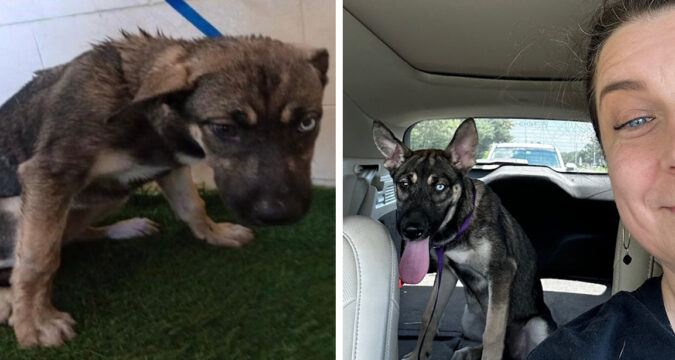
The German shepherd/husky mix puppy Nicole Odell adopted last year from the Polk County Animal Control came home bleeding, vomiting and suffering from a highly contagious infection.
“It’s hard for me to understand how she could be there for so long and be so sick … pooping blood and throwing up,” Odell said.
For the previous two weeks, she had worried the dog would be euthanized before she could take it home. Each time she called, she was told her dog was too sick to be spayed, a procedure the shelter requires before adoption.
Finally, Odell received the call that the roughly 12-week-old dog, Anya, was healthy enough to be brought home.
“As soon as they bring her out to me, it’s immediately obvious that she’s still sick,” Odell said. “She’s got snot coming out of her nose and her wound is still bleeding.”
Her experience was not unique.
For years, the Polk shelter has been plagued by allegations of mismanagement, abuse and neglect. Animal rights activists, many driving from Orange County, have sound the alarm at Polk County Commission meetings. But county officials don’t want to take control of the shelter from the Polk County Sheriff’s Office, which runs the facility.
The shelter has the highest euthanasia rate in the state, according to data collected by the University of Florida’s College of Veterinary Medicine’s shelter census. The shelter’s rate of euthanasia, animals dying in its care and animals marked as missing — a combination UF calls the “non-live” rate — is also higher than other shelters across the state.
The Polk shelter, for example, had a “non-live” rate of nearly eight animals per 1,000 residents, UF said, while much larger Orange and Hillsborough counties had rates of less than one animal per 1,000 residents.
In Polk, the shelter in 2024, euthanized 3,561 cats and 1,741 dogs, had 96 dogs and 305 cats die in its care and lost 13 dogs and 557 cats. By comparison, Orange County Animal Services euthanized 509 dogs and 770 cats in 2024, had 41 dogs and 100 cats die and lost only one dog and five cats.
“There is something really wrong here,” said Vicky Quintanilla, a Winter Park social worker, who has been driving to Polk to push for better care at the animal shelter.
She and others are upset that the Polk sheriff’s office recently ended its shelter volunteer program and banned cell phones in the kennels where animals are kept.
An Orlando Sentinel reporter visited the shelter on a September afternoon. Upon entry, visitors are greeted with a large photo of Polk County Sheriff Grady Judd smiling while holding a German shepherd puppy. In order to look at any cats or dogs, visitors must secure all phones, purses and bags inside a locker or in a car.
A uniformed officer took visitors inside a gated section where dogs were housed inside an open air unit without air conditioning but with an industrial sized nearly floor-to-ceiling fan. Many of the dog kennels were broken, with holes in the cages where the dogs stuck their noses to greet passersby.
Many of the plastic cots the dogs are sleeping on were also broken, and some still had pools of water from an earlier cleaning.
The facilities are cleaned by inmates and the animals are fed twice a day, shelter employees said.
A second uniformed officer escorted visitors into the enclosed kennels where dozens of cats were kept. Two had open wounds, one had a large gash the size of a fist on its chest. Another cat had dried diarrhea all over its cage. Many cats had food inside their litter boxes.
The Sentinel spoke with nearly a dozen people who had recently visited the shelter, adopted a pet from the shelter or volunteered before the program ended. They described the shelter as “harmful for the animals”, “dirty” and “poorly managed”.
Some described seeing the ribs on very skinny dogs and cats panting or sleeping in their own feces. Others described seeing inmates hose down kennels with dogs still inside, and many dogs sleeping on sopping wet broken beds.
Polk County Board of County Commissioners and the Polk County Sheriff’s Office did not respond to the Orlando Sentinel’s multiple requests for comment nor answer any questions about shelter operations.
Animal shelters in Florida are not registered or inspected by the state, said Julie Levy, a UF professor and director of UF’s Shelter Medicine program, in an email.
While Levy said UF doesn’t track shelter policies, she said many shelters rely on volunteers to supplement the work of their staff, with volunteers often using cellphones to take photos and videos that can be used to promote animals’ adoption.
Vicky Quintanilla at her Winter Park home, Friday, Nov. 21, 2025. Quintanilla is one of the leaders of a group that is pushing for reform of Polk County Animal Control in Winter Haven. The agency has the highest rate of animal euthanasia in the state. (Joe Burbank/Orlando Sentinel)
Quintanilla and a group of others have garnered support for Polk shelter improvements through social media, visiting the shelter and advocating for better policies. But their efforts and ideas, already adopted by neighboring counties, are falling on deaf ears, she said.
“We’ve been going to commission meetings month after month after month,” she said.
She and the group have asked commissioners to take control of the shelter from Judd, arguing he is unfit to run the center and isn’t transparent about what happens there.
Eve Salimbene worked as manager of the neighboring Lake County Animal Shelter in 2018, just as the county was taking over control from the Lake County Sheriff’s Office and transitioning to a no-kill shelter, she said. Now she is helping lead the fight for change in Polk.
Salimbene said she’s concerned the Polk shelter is using the outdated “heart-stick” method to euthanize the animals, which Lake County used before she took over. That method allows a very long needle to pierce the heart of the animal quickly and without anesthesia.
But it can be painful if an animal moves suddenly, Salimbene said. She worries at the rate animals are euthanized at Polk, the shelter may be using this method instead of more humane ones that sedates animals first.
“If you’re going to kill 400 animals a month, there are not enough hours in the day that you would have time … to anesthetize prior,” she said.
Polk County Sheriff Grady Judd listens during a meeting, Wednesday, Nov. 16, 2022 at the FLA Live Arena in Sunrise.
Bob Weedon, currently a spay/neuter surgeon in Polk after a 40-year career as a veterinarian and at the University of Illinois College of Veterinary Medicine, has asked Polk commissioners three times this year to follow in the footsteps of Hillsborough and Orange counties.
Both manage stray cat populations by trapping, neutering or spaying them and then returning them to their outdoor location. This method could help lower the stray cat or dog intake at the Polk shelter, which according to data from UF ranks the highest among neighboring counties.
“Spaying and neutering helps prevent reproduction, which then helps prevent animal overpopulation,” Weedon said. “The problem is there are so few resources in Polk County for low-cost sterilization.”
But commissioners were not receptive. After Weedon’s second presentation to the board in June, they told him the sheriff’s office has jurisdiction. He sent the board follow-up letters to which they never responded, he said.
“Grady runs animal control, but you all have the power to embrace trap, neuter, vaccinate, return and make it law in our county,” Weedon said.
Commissioners seem afraid to challenge Judd, he added. ” Honestly I respect him as a law enforcement officer. But so far as he runs animal control, not so much.”
Shortly after leaving the shelter in such poor condition, Odell’s dog Anya was rushed to the vet to be treated for a parasitic illness that can cause diarrhea and is transmitted through contact with contaminated feces.
Today, Anya is healthy and living in Pennsylvania with Odell’s daughter.
“I just wanted her to have a shot at a good home and a good life,” Odell said of Anya. “Gosh, that had to be so much for a little baby puppy to go through by herself.”