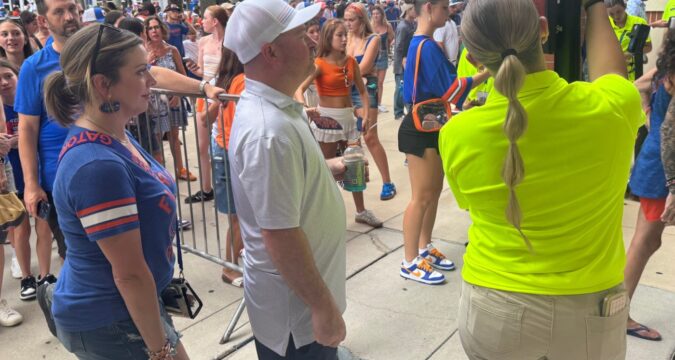
GAINESVILLE — Leave your tickets at home, just bring your face.
The University of Florida’s latest pitch to students marks a new era in college football: using facial authentication for ticket holders who use Express Entry by Wicket. The opt-in system, the first used in college sports, was marketed to fans as a quicker way to access the stadium, as they can walk through facial scanners rather than pulling out their phone or ticket.
“Just thought it would be easier to access the stadium and flip through my ticket, so quick selfie and in we go,” Amy Bapst, 40, said Saturday of the system’s debut before the host Gators crushed Long Island University 55-0.
Her daughter, Kira, wanted to experience the college atmosphere as a prospective student from Baltimore. So the two made sure to add a trip to the Swamp to their university tour.
“I really like the big-school atmosphere. Like, when I was coming here, this is what I was looking forward to the most. Like everyone, you know, tailgating and, like, the camaraderie of gameday,” Kira said.
To get ahead of problems, the university encouraged attendees to keep their tickets in an accessible location when finding seats inside the stadium. However, on first use, Florida is still working out some flaws.
Ticket-holding fans would line up at the scanners without their friends or family, and they would be ushered in, leaving the others stranded on the other side. Some people accidentally lined up in Express Entry lines instead of the regular ticket line.
Yet longtime Gator fan Kyle Polter, 31, felt it was a better system than using a regular ticket.
“Well, a couple of our friends, they came for the Ole Miss game. They missed the first half trying to get in,” he said.
Polter has watched the team for 15 years. His wife, Emily, joked that she married into a Gator family despite being from Long Island originally. She’s latched onto the team since then, especially because of center Jake Slaughter, whom she deemed her favorite.
Neither was concerned about the usage of technology. Emily compared it to visiting Disney World, which uses a similar type of facial recognition software.
While the Gators might be the first in the nation to use the system for college sports, the technology has existed for many years in professional leagues. The Tampa Bay Buccaneers use the system at Raymond James Stadium for fan entry. Still, it isn’t without controversy. New York Knicks and Rangers owner James Dolan has used facial recognition software to deny entry to lawyers from firms suing Madison Square Garden.
Both the UF and Wicket, the company the school partnered with, are quick to clarify that any data collected is “handled securely” and will not share or store any biometric data. The university said the technology would not be used to ban fans or enforce previous bans.
“It’s simply to authenticate that they have tickets to the game and to get them into the stadium faster,” a spokesperson with the University Athletic Association said.
Florida fans weren’t entirely convinced. Just about 6,000 people signed up for the Express Entry lines for the expected sellout matchup against Long Island University. The lines at the gates that didn’t use the technology were significantly longer, and some fans recoiled at the thought of UF scanning their faces.
Cam Sevald, an 18-year-old freshman fan waiting in the Express Entry line, worried about the biometrics leaking, even though he understood that using facial recognition on his phone could cause similar problems.
“It’s concerning for me. I don’t know. You never know how data can get leaked and all that nowadays and all that,” he said.
Yet, he said that it was worth it if he could avoid waiting in line, which in his experience has lasted for more than an hour.
Kara Harrington, another freshman, signed up for the tickets after Florida sent out an email to students encouraging them to sign up. She felt assured by the fact that her tickets would only be accessible to her.
“After thinking about how long the typical entry lines are going to be and the fact that it was free, I was like, ‘Sure, yeah, totally,’” she said.