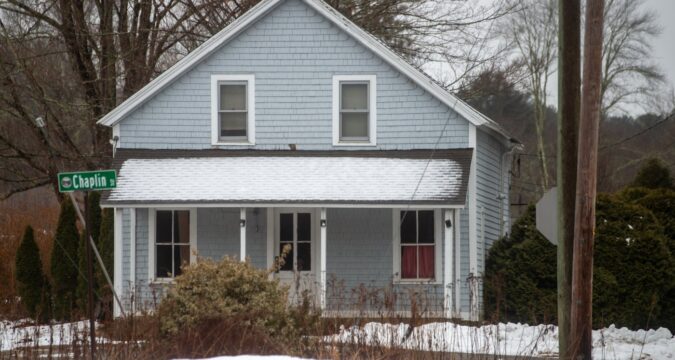
Nestled in the tiny eastern Connecticut town, the century-old building that once housed Burdick’s General Store appears to be an ordinary, benign example of historic New England architecture.
But it was used for some time as a gas station in Chaplin, and has stood mostly empty for 23 years because developers don’t want to take on the risk of trying to renovate a potentially contaminated property.
For a community of under 2,200 residents with a tiny tax base and small public works staff, there had been no practical way to deal with that problem. So the 151-year-old building along Chaplin’s busiest road stayed empty for the past two decades.
That could be changing, though. In December, Chaplin received a $50,000 state brownfields clean-up grant to pay for an environmental study to get the property back in use. Officials are hoping that once engineers complete the testing, they can land a larger grant to hire a remediation contractor and get the property ready for a new use.
“Nobody touches a gas station until you know what’s there and it gets cleaned up,” said Jim Rivers, executive director of the Northeastern Connecticut Council of Governments. “It really needs to be cleaned up before you see (private) investment in an old site like that.”
Rivers is a prominent advocate for using brownfields grants to help rural communities as well as big industrial cities.
Like officials in northwestern and southeastern Connecticut, he works to present the case that decades-old contamination is harming properties in small villages as well as the much-better-known shuttered brass mills and ball bearings factories in cities like Bridgeport, Waterbury or Meriden.
“We have a lot of properties in northeastern Connecticut that need attention. There are a lot of mills, and there’s a lot of cleanup to be done,” Rivers said last month when the state department of economic and community development handed out $28.2 million in grants to either analyze or clean up 16 blighted properties.
The former Burdick’s General Store in Chaplin on Wednesday, Jan. 7, 2026. (Aaron Flaum/Hartford Courant)
“If you’re in the private sector and have an eye on a property, you have to have some certainty that it will have endgame that will give you some return. When you don’t have any idea of what’s under the ground or in the buildings, you’re not going to even take a go at it,” Rivers said.
James Harrington, first selectman of Chaplin, believes the property at 142 Chaplin St. has the potential for successful commercial use since it’s in a historic district and located directly between the senior center/library and the town hall and Garrison Park. The town plans to put in sidewalks to better connect those services, making the site even more valuable, he said.
“The ability to transform a vacant property with environmental concerns into a community asset is essential. This assessment is the first step,” he said.
In December the Lamont administration distributed the last of its 2025 brownfields grants, which will help bring 16 properties on more than 200 acres back into productive use, said Matthew Pugliese, deputy commissioner of state economic and community development.
He said his staff knows well that contaminants have damaged properties in all parts of the state, and said all 169 towns and cities have at least one site that would qualify for cleanup.
“Brownfield sites exist in every town. They are different sizes. When you look at the former post office in Chaplin for example, the contamination might come from the presence of hazardous materials used in building materials at the time, including asbestos, lead and PCBs found in materials like window caulk,” he said. “Contamination might also be from past historical uses over the life of the site.”
Regional planners often take the lead in getting small towns lined up for brownfields aid.
“In northeastern Connecticut, there are towns that don’t have the resources to even put together grant applications,” he said.
With help from planning agencies, though, they can sometimes secure substantial aid. Plainfield, for instance, last year got $8 million from the state Bond Commission to clean a sprawling abandoned mill property that it plans as the heart of a town center.
Typically funding is awarded through the DECD program, and Pugliese said his agency is eager to see many communities apply for the next round of aid this winter.
Among the recipients of the December funding were the small communities of Ashford and Willington, which are trying to deal with the more than 350-acre contaminated Candlerock property. The state is helping pay for an environmental assessment and market analysis for part of the tract.
“When a community inherits something like this, it can be onerous,” Willington First Selectman Mike Makuch said. “That’s particularly notable for rural communities like ours. The cost and even the management process is sometimes beyond our resources.”