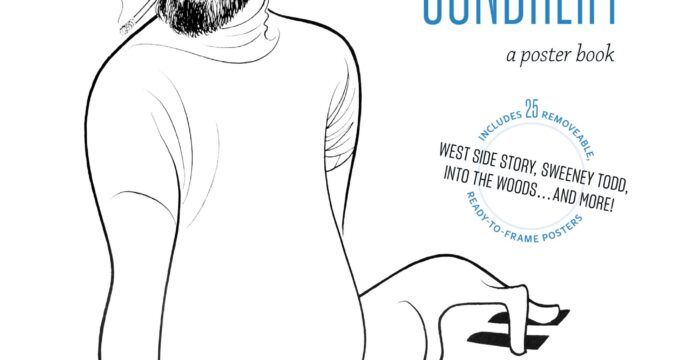
Remembrances of Stephen Sondheim — the great composer, lyricist and puzzle-setter who also happened to be a longtime Roxbury resident — have not let up.
Sondheim died nearly four years ago at the age of 91, and his musicals seem to be getting produced more than ever. This month in Connecticut alone, Connecticut Theatre Company in New Britain is staging the revue “Sondheim on Sondheim” through Sept. 15, while TheaterWorks Hartford, which is collaborating with Hartford Stage on a production of Sondheim’s musical “Sweeney Todd” at the end of the 2025-26 season in June, is kicking off the season with a gala concert of Broadway stars singing Sondheim songs on Sept. 13.
‘Tis the season for the Demon Barber of Fleet Street: the Legacy Theatre in Branford just did the show in August, and the Little Theater of Manchester is producing it in November.
Archives acquired from legendary Broadway composer with CT ties show how his magical songs were made
Now you can add to this heady mix the oversized, beautifully wrought poster book “Hirschfeld’s Sondheim.” The slim but information-packed and highly artistic volume is devoted to depictions of Sondheim shows — and of Sondheim himself — by the iconic pen and ink artist Al Hirschfeld. Most of the art in the book was created to accompany theater reviews and feature stories in the New York Times, where Hirschfeld’s drawing regularly graced the Sunday Arts section for decades.
“Hirschfeld’s Sondheim” is a classy, affordable collection of crisp, neatly reproduced large-scale drawings on thick paper Each page is ready to be pulled out and tacked to the wall of a theater’s green room, a drama school’s dorm room or backstage wall.
The book is much more than a picture book, however. It’s a deeply researched, enlightening and illuminating compact history of Sondheim’s entire career. The backs of each poster page is full of text describing the show depicted on the other side of that page. The book begins with the 1957 mega-hit “West Side Story,” for which Sondheim provided the lyrics for Leonard Bernstein’s music. It ends with a section from a mural Hirschfeld designed in 1999 for the Prince Music Theater in Philadelphia named in honor of Broadway producer/director and frequent Sondheim collaborator Harold Prince. The book’s cover and one of its last pages is filled with large portraits of Sondheim at work. In both of them, Sondheim is drawing notes on music scores with one hand while playing a piano with the other.
Al Hirschfeld’s rendition of “A Funny Thing Happened on the Way to the Forum,” the first musical for which Stephen Sondheim provided both the music and the lyrics. The show had its world premiere as a pre-Broadway try-out at the Shubert in New Haven, where audience confusion at what kind of show it was trying to be led to the creation of the opening number “Comedy Tonight.” (The Al Hirschfeld Foundation)
“The two men were friends. Sondheim was a collector of Hirschfeld’s work. They were also both first-nighters, who saw each other at the theater on a regular basis,” said David Leopold, who not only compiled the art for “Hirschfeld’s Sondheim” but crafted its text. Leopold is the creative director of the nonprofit Al Hirschfeld Foundation and has crafted several books and gallery exhibits prior to this concerning other aspects of Hirschfeld’s work.
Besides explanations of every drawing in the book and a careful accounting of the careers of both Sondheim and Hirschfeld, “Hirschfeld’s Sondheim” also contains an introduction by Bernadette Peters (Broadway star of Sondheim’s “Into the Woods” and “Sunday in the Park With George”) and a reprinting of an essay by former New York Times theater critic Ben Brantley that ran in that paper when Sondheim died in 2021. Leopold thought the essay worked so perfectly as a foreword for this book that he could scarcely believe it had been written years earlier for a different purpose. Its title? “These Hirschfeld Drawings Capture Sondheim’s Shows Better Than Any Photo.”
“These are contemporaneous accounts of these shows, drawn from life,” Leopold said. “They tell an incredible story.”
Leopold conceived of the idea of a book devoted to Hirschfeld’s Sondheim art, but the project hit a new level when Charles Kochman, who edited the book for the esteemed art book publishing company Abrams, suggested that it be a poster book. “I didn’t even know what that was,” Leopold said. “Until I held this book in my hands I didn’t understand.”
Though “Hirschfeld’s Sondheim” is very Broadway-centric, given that Hirschfeld was doing his art on assignment for the New York Times, many shows that Sondheim was involved with had out-of-town tryouts in Connecticut, and it’s there that Hirschfeld might have seen and drawn them so that he could make his deadlines.
“He would prefer to draw from life,” Leopold said, though Hirschfeld would sometimes have to work from photographs and other references. “New Haven was a regular stop for him. He was a visual journalist — he wanted to get the facts right. He’d go to performances and make sketches. He trained himself to draw in the dark.”
A 1999 portrait of longtme Roxbury resident and even longertime Broadway icon Stephen Sondheim by Al Hirschfeld, from the poster book “Hirschfeld’s Sondheim.” (The Al Hirschfeld Foundation)
Some Sondheim shows are not represented, but in most cases it’s because they never made it to Broadway or because Hirschfeld didn’t happen to draw them. Some drawings that would be appropriate for the book were created as limited edition prints, so Leopold took the ethical stance of not mass-producing images that were created for a specific collectible market or as unique pieces for friends.
The 1974 world premiere of “The Frogs,” staged by Yale Repertory Theatre in the university’s Olympic-size swimming pool, isn’t in “Hirschfeld’s Sondheim,” for example. “He never drew ‘Bounce’ or ‘Road Show,’” Leopold said, naming two late-career musicals that Sondheim tinkered with endlessly on the road, “but he drew all the important productions. It shows how complete Hirschfeld’s archive of American theater was.”
There are plenty of lesser-knowns and obscurities among the household-name hits in “Hirschfeld’s Sondheim.” “Getting Away With Murder,” the 1996 non-musical play Sondheim co-wrote with his “Company” and “Merrily We Roll Along” collaborator George Furth, gets its own poster page. So does a previously unpublished drawing of Sondheim pictured alongside two other preeminent theater composers of the 20th century, George Gershwin and Jerome Kern, and an image of Julie Andrews as she appeared in the 1993 Sondheim revue “Putting It Together.” There’s even a promotional drawing Hirschfield did for the Sondheim-scripted murder mystery movie “The Last of Sheila.”
“We did a tremendous amount of new photography just for this book. When possible, we tried to shoot from the original art,” Leopold said. That wasn’t always possible because some of it had been given away to people involved in the shows or covered with autographs from the casts and crews.
Luckily, it was the Times’ practice to make full-size reproductions of all Hirschfeld’s drawings for the paper. Once the art was published, the reproductions were given to Hirschfeld. The artist simply stuck them in a pile in his studio. That pile of art was what brought Leopold into Hirschfeld’s world. Leopold had been creating an exhibit on a different artist who drew Broadway shows, Ben Solowey, for the New York Public Library and contacted Hirschfeld for some information related to the show.
“He invited me to visit and ‘quaff some tea,’” the archivist recalled. “A few weeks later, I was asked to archive his work. He was 86 then and when I accepted the job, I thought ‘How long could this be?’ I ended up having a real bond with him. He did not live in the past at all. He was still very active. If I had a question, he could help, and I could help him, too. He knew what he had drawn, and I’d know where to find it.”
Not only did Hirschfeld live to the age of 99, dying in 2003, Leopold’s work helped bring the artist’s work back into the public eye. When a foundation formed to preserve and share the art, “I was the first hire,” Leopold said.
A 1989 self-portrait by legendary Broadway artist Al Hirschfeld, whose drawing of Stephen Sondheim shows have been collected as “Hirchfeld on Sondheim: A Poster Book,” published by Abrams. (The Al Hirschfeld Foundation)
If advance orders have been any indication, the “Hirschfeld’s Sondheim” poster book may become the most popular of any of the print collections of Hirschfeld art.
“Hirschfeld’s Sondheim” is the first in a two-book deal the Al Hirschfeld Foundation has with Abrams. Leopold is already at work on the second, “Hirschfeld’s Icons,” which will contain portraits of such immediately recognizable names and faces as Elvis Presley, Ernest Hemingway, Lena Horne, Sammy Davis Jr., Ray Charles and Lassie.
Given the success of the poster concept, Leopold would like to compile a book of actual posters Hirschfeld drew, including such items as the movie posters he drew for the Marx Brothers MGM comedies, Mickey Rooney/Judy Garland musicals and more. Hirschfeld also drew more “TV Guide” covers than any other artist, another trove of images begging for quality reproductions.
“Hirschfeld’s Sondheim” is being released on Sept. 9. The release date dovetails with a differently themed exhibit of Hirschfeld’s work in New York City. “Strokes of Genius: Hirschfeld at the Algonquin,” which features his portraits of great artists who lived, ate or performed at the Algonquin Hotel, will be displayed in that hotel’s famous Oak Room from Sept. 9-20. It’s the first gallery exhibit of Hirschfeld’s in his longtime hometown of New York City in over a decade.
Leopold will be in Connecticut on Oct. 29 at 7 p.m. to hold a benefit event, “Hirschfeld’s Broadway,” at The Katharine Hepburn Cultural Arts Center in Old Saybrook.
Since most of Hirschfeld’s work involves the American theater realm, Leopold finds deserving small theaters that Hirschfeld himself would feel comfortable in, then “I tell stories for about an hour. I tell stories of his drawings.” He also sells Hirschfeld drawings and prints and donates the proceeds to the theater. “We can make $10,000 or $20,000 for a theater,” he said.
When possible, Leopold gears the presentation to a famous performer associated with that venue. This edition of “Hirschfeld’s Broadway” will contain a section devoted to Hepburn’s live stage career.
Leopold noted that Hirschfeld’s status as an artist who comprehensively covered the American theater for half a century has a lot to do his innate talent and not just the fact that he lived to be very old.
“As American drama became more about regular people, that should have been the end of the caricaturist,” Leopold said. “Hirschfeld gave them character. He preferred the term ‘character artist’ to ‘caricaturist.’ He came late to the field, but then he became the field. He had an 82-year career because he was very good.”