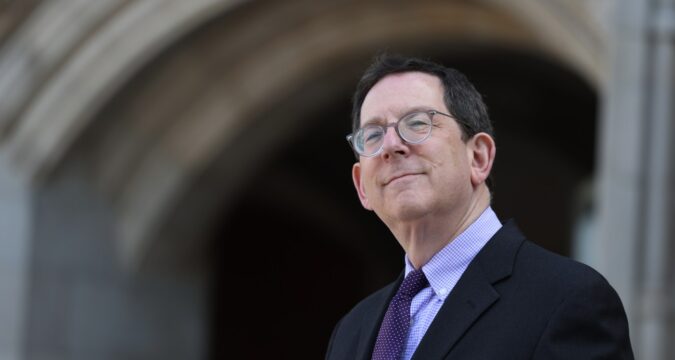
Faculty members and students are reeling with a mix of relief, uncertainty and frustration after Thursday’s announcement that Northwestern University President Michael Schill has resigned — reigniting divisive campus debates over the school’s handling of protests, allegations of antisemitism and federal pressures under his turbulent three-year tenure.
Some expressed sympathy for Schill, 66, noting the unprecedented attacks on higher education under the Trump administration. Others say they were glad to see him go.
Northwestern and its leader had emerged as a high-profile target of President Donald Trump and House Republicans, who have accused elite universities of fostering hostile environments towards Jewish students. Schill’s term was bookended by an unprecedented $790 million federal funding freeze, which came amid multiple federal investigations into alleged antisemitism.
“The threshold for surprise is pretty high these days, so I can’t say I’m surprised — but I am confused,” said Jackie Stevens, a political science professor at Northwestern University and the president of the school’s chapter of the American Association of University Professors.
Stevens, who has been vocal in her criticism of Schill, noted that he heeded many of the Trump administration’s demands in its crackdown on academia, including adopting the International Holocaust Remembrance Alliance statement on antisemitism — one of the many steps the university took in the aftermath of a student-led pro-Palestinian encampment on Deering Meadow in the spring of 2024.
The dayslong protest called for Northwestern to divest from its ties to Israel, which had waged a heavy military response on Gazan civilians in the wake of Oct. 7, 2023. After five days, skirting around the threat of arrest and disciplinary action, student organizers managed to strike a deal with Schill, ending the protest without cops or violence — something Northwestern’s counterparts at most other campuses had not been able to do.
Students agreed to dismantle the encampment. In return, Schill promised transparency into Northwestern’s investments, while also vowing to establish an affinity space on campus for Middle Eastern and North African students. He also agreed to pay to educate five Palestinian undergraduates at Northwestern.
Schill, who identifies as Jewish, was called to testify before the House Committee on Workforce and Education in May 2024 and was grilled for hours for “negotiating with protesters.” And soon Jewish advocacy groups, including the Anti-Defamation League and the Brandeis Center, began calling for Schill to resign.
Philip Greenland, a professor of cardiology, expressed deep frustrations Friday with Schill’s congressional testimony and his handling of the encampment. Greenland was one of the seven members of Schill’s Advisory Committee on Preventing Antisemitism and Hate who stepped down amid the protests.
Schill repeatedly failed to counter antisemitism on campus, he said.
“For much of his tenure he was not prepared for the job, and his approach to a number of the challenges that he faced seemed either inappropriate or inadequate,” Greenland said. “I will not miss him.”
But longtime faculty members, including Schill’s critics, quickly rejected the notion that there is a widespread crisis of antisemitism on Northwestern’s campus.
Northwestern University President Michael Schill testifies at a hearing before the House Committee on Education and the Workforce on Capitol Hill in Washington on May 23, 2024. (Michael A. McCoy/Getty)
Several professors agreed that antisemitism, like other forms of discrimination, exists and should be addressed. But the federal government’s ongoing campaign of withholding research funds, interfering with academic programming, calling personnel decisions, surveilling students and imposing congressional hearings is not aimed at protecting Jewish students or Jewish faculty members, they said.
Noah Cooper, a rising sophomore at Northwestern and a member of the campus’s Jewish Voice for Peace, believes more could have been done at the administrative level to protect the students who advocated on behalf of Gaza or Palestinians. “We know what campus was like while he was in charge,” he said. “We hope that the next president will work with us to create a safer campus.”
At the start of the winter quarter in January, all Northwestern students and faculty and staff members were required to undergo a 17-minute training module on antisemitism, produced in collaboration with the Jewish United Fund. The training also covered anti-Muslim, anti-Palestinian and anti-Arab discrimination.
After the training and other changes to Northwestern’s student code of conduct were implemented, the Anti-Defamation League increased the school’s score in its Campus Antisemitism Report Card from an F to a C.
Hazing scandal looms
Earlier in his tenure, Schill faced other challenges, including a hazing scandal that eventually led to the firing of Northwestern’s top football coach, Pat Fitzgerald.
In July 2023, Northwestern suspended Fitzgerald for two weeks after an investigation found reports of hazing in the football program. Only after former players came forward with details of the alleged hazing did Schill fire Fitzgerald, admitting later in an open letter that he may have erred in his initial decision. Fitzgerald announced in August that he reached a settlement with Northwestern after he sued the university $130 million.
Some faculty members on Friday wondered if he was fired by the board of trustees and then decided to resign.
Stevens, the political science professor, speculated whether the timing of the hazing settlement might’ve been the “last straw” for Schill.
“They owe us an explanation as to what went wrong with (Schill’s) appointment,” Stevens said.
Mounting federal pressures
Recent federal pressures were also at the forefront of many faculty members’ minds Friday. Schill himself acknowledged “difficult problems” at the federal level in his resignation statement.
Amid the $790 million federal funding freeze, school officials were forced to make deep budget cuts — including the elimination of more 400 positions in July, as well as a hiring freeze and changes to employee benefits. Those measures, coupled with other federal cuts, caused panic among faculty.
Melissa Simon’s research hub, the Center for Health Equity Transformation, was shuttered in May as the university scrubbed diversity, equity and inclusion initiatives to comply with federal directives. Simon, the vice chair for research in the Department of Obstetrics and Gynecology, said she is sympathetic toward Schill despite having signed a July letter from Northwestern’s Concerned Faculty Group urging him not to make a deal with Trump.
“I can’t even begin to imagine the extraordinary pressure on him over the last three years, let alone the last seven and a half months,” she said.
For months under Schill’s leadership, Northwestern has seen its counterparts capitulate to Trump’s demands.
Several Ivy League universities — including Columbia University, the University of Pennsylvania and Brown University — brokered agreements with the White House to restore their paused funds. In exchange, the schools committed to new measures to combat alleged antisemitism on campus.
“If that’s the situation that you’re dealing with, I can understand why Schill might just feel like he can’t fight against those pressures,” said Ian Hurd, a political science professor and president of the Faculty Senate.
In his resignation announcement, Schill said he would remain in the role until an interim president is named. Once he steps down, he will take a sabbatical before returning as a faculty member at the Pritzker School of Law.
Schill’s resignation follows a string of university leaders who have resigned in recent months while under fire from the White House and Congress. University of Virginia President James E. Ryan stepped down in June amid a federal probe into the school’s DEI efforts. Earlier, the presidents of the University of Pennsylvania, Harvard University, Columbia and Cornell University resigned in the wake of pro-Palestinian campus protests.
“The difficulties of the moment are intentionally created to make jobs like president of the university impossible,” said Ian Hurd, a professor of political science and president of Northwestern’s Faculty Senate. “It just gets in the way of the teaching and the research that the university provides to society.”
https://www.chicagotribune.com/2025/09/07/northwestern-president-michael-schills-exit-reaction/