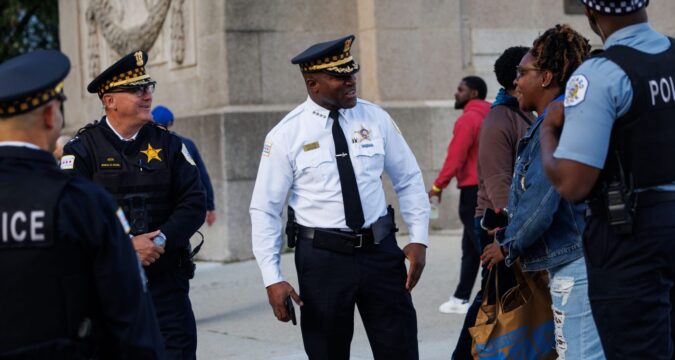
The recent editorial regarding Chicago police Superintendent Larry Snelling was informative and encouraging (“A frank conversation with Superintendent Larry Snelling, Chicago’s top cop,” Sept. 17). I have family members in the department, and they universally endorse Snelling. It’s nice to see how CPD is collaborating and cooperating with the Cook County state’s attorney’s office and other local and federal law enforcement agencies under Snelling’s watch.
The board mentions the positive impact the cops are having at 31st Street Beach by “standing and observing.” I’m wondering why having National Guard troops “standing and observing” in the Loop and on the Mag Mile would not provide a similar benefit making locals and tourists feel safe while freeing up CPD officers (still 978 officer vacancies by the board’s count) to police the highest crime areas.
Personally, I have no problem seeing armed military stationed in the city for the same reason I have no problem with armed military patrolling international airports in Rome, Amsterdam, Frankfort, etc.
It’s time for our mayor and governor to be smart and proactively collaborate with the Donald Trump administration regarding where help from the guard and/or other federal agencies might be deployed to actually do some good.
— Jim Barrett, Chicago
Among the best of the best
“Come to think of it, we hadn’t.”
The Tribune Editorial Board’s acknowledgment that it hasn’t seen teen gatherings like it has in the past is the most impactful accolade to Superintendent Larry Snelling in the editorial.
It best underscores the editorial board’s point that Snelling and his officers stay away from politics and do not seek the spotlight even when praise is well deserved.
In a city overwhelmingly full of good people, Snelling is among the best of the best. The adult in the room.
I, too, am glad Snelling is on the beat.
— Mike Cello, Chicago
Honorable public servant
The state of Illinois has lost an honorable and devoted public servant with the passing of former Gov. Jim Edgar.
Reading the article on his life and career by reporters Rick Pearson and Ray Long (“Former Illinois Gov. Edgar dies at 79,” Sept. 15) and Sept. 16 tributes from Bob Kustra (“Jim Edgar’s tenure as governor is a reminder of politics’ better days”) and Jim Nowlan (“Jim Edgar was proud to be governor of the state he loved”), I was reminded of a time when politicians (not to mention the public in general) could work together for the common good, despite different points of view.
My personal memories of Edgar date to the early days of his political career when he was an aide to Illinois House Speaker Bob Blair. Later in life, when I’d left politics for the private sector, our paths crossed again when the book-loving governor hosted a reception at the new State of Illinois Center for participants in an international rare-book fair being held at the Palmer House. My fellow antiquarian dealers were impressed by the architecture, but some were dismayed to find the teetotaling host would not be serving alcohol at the event!
Condolences to the Edgar family.
— Mary McMichael Ritzlin, Highland Park
Here to bring us hope
In these turbulent times, it is easy to get lost in the chaos and noise of the world around us. It is easy to succumb to negativity and hopelessness when it seems there’s nothing that can prevent the hurt and destruction around us.
The American Foundation for Suicide Prevention is here to bring us hope. During September, we are celebrating the strides we’ve made to prevent suicide, promote mental health and save lives. We are excited to bring thousands of people together at our annual Out of the Darkness Community Walk, to bring hope and help those who are struggling or feeling lost. The walk takes place at Chicago’s Montrose Harbor on Saturday. Here, attendees will be surrounded by people who have lost someone to suicide, are experiencing mental health challenges of their own or have survived a suicide attempt. Others — who are advocates for mental health and want to create the changes we need to see in our world — will also be gathered together in community and stewardship.
We also want everyone to know that we are here for you. You matter. Your life matters. Please know that if you feel invisible, if you are frustrated with the circumstances of your life, there are people who care about you and want you in this world.
It is equally important to take a look around: to see others, to hear others and to be there for each other. We all want to be seen and heard. It is easy to forget the impact a smile or friendly face can have when someone is feeling down or losing hope. Ask a simple question like “How are you?” and really listen when someone answers you. Your presence, your care and your concern can save someone’s life.
During Suicide Prevention Month, I encourage you to extend a loving hand to yourself and others. Here are five simple things you can do.
Connect with your body, mind, and feelings. Extend compassion and grace wherever you are right now.
Care by showing concern for those around you and finding community in trusted others.
Celebrate your wins. Sometimes getting through the day is reason enough to celebrate.
Call on others when you need extra support or care.
Challenge yourself to learn more about mental health and suicide prevention.
Learn more at www.afsp.org/illinois or www.Chicagowalk.org.
— Dr. Cynthia Paidipati, Chicago
Affirm inherent dignity
Earlier this month, we observed National Suicide Prevention Week, reaffirming our social commitment to protect and honor the inherent dignity of every person’s life.
Yet, Illinois lawmakers are poised again to consider assisted suicide, with proponents wrapping their advocacy inside the euphemisms “death with dignity,” “autonomy” and even “mercy.”
But such phrases are fraught with deception. Dignity is not diminished by dependency, illness or incapacity. One’s inherent worth doesn’t depend on youth, health or autonomy. Nor can human dignity be regained by one’s self-induced or medically assisted demise.
Dignity is not a privilege bestowed by youth, health, beauty or capacity. It is inherent in every person, rooted in our creator’s endowing each of us with natural rights — to life, liberty and the pursuit of happiness. As proclaimed in our Declaration of Independence, this truth is America’s cornerstone that defines the essential worth and equality of all our citizens.
The experiences of states that legalized physician-assisted suicide reveal the consequences of abandoning this truth. Promised comprehensive safeguards have been routinely undermined by woeful failures, as reported by UnHerd: Washington lost track of over 500 compliance forms, Colorado lost nearly 1,800, and Oregon officials confessed to not knowing if 178 patients lived or died after receiving lethal prescriptions.
Worse, in 2023, half of Washington patients who sought assisted suicide and died, cited feeling like a burden as an end-of-life concern. These are not the fruits of mercy.
Our society is being tempted to reinforce this misguided message. As more suffering and marginalized citizens internalize this message, that their lives are burdensome on others, they, too, may increasingly opt for assisted suicide to undo their perceived “burden.”
We have a responsibility instead to respond by enacting policies that reaffirm their inherent dignity and strengthen our commitment to palliative care.
Every person’s dignity is inherent and essential, not bestowed by mere “choice” nor diminished by suffering, and surely not salvaged by suicide. Our Land of Lincoln must renew its commitment to protecting and caring for every member of our society, especially the suffering, weak and vulnerable.
— Thomas Brejcha, founder and president, Thomas More Society, Chicago
Submit a letter, of no more than 400 words, to the editor here or email letters@chicagotribune.com.
https://www.chicagotribune.com/2025/09/24/letters-092425-larry-snelling/