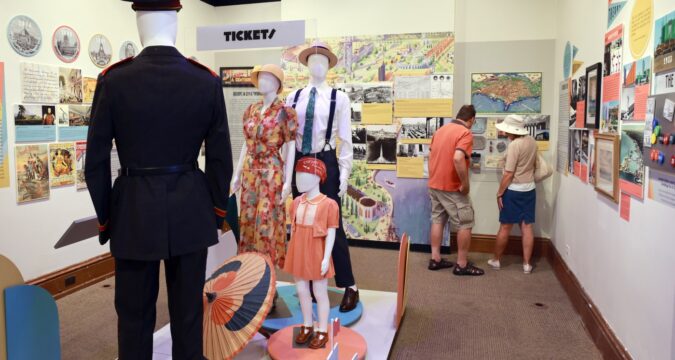
A mannequin family in colorful period clothing and an array of bright posters and displays greet guests as they enter the “World of Tomorrow: A Century of Progress” exhibit at the Elmhurst History Museum.
In 1933, Chicago hosted its second World’s Fair in 40 years to celebrate its centennial. It was titled “A Century of Progress International Exposition.” The first World’s Fair was held in 1893 under the name “World’s Columbian Exposition” to celebrate 400 years since Christopher Columbus’ arrival to America.
Tens of millions of people from all over the world came to the 1933 fair to get a glimpse of hope for the future — for a fee of only 50 cents (about $12 in today’s currency) for adults and 25 cents for children.
The fair gave countries and companies a way to showcase their latest and greatest innovations, such as the sky ride, a cable car spanning the fairgrounds that allowed riders to see Chicago from above. It was a main attraction at the fair, according to Sarah Cox, the curator of exhibits at the Elmhurst museum.
“It was the center point because it was about the advancement of transportation,” Cox said.
A wall of the museum is dedicated to showing the technology during that time period. Museum visitor Marie Bartlett, 76, remembered how her dad used to talk about the fair when she was younger and how transportation evolved during his life.
“My dad had been born in 1901, so he went from horses and wagons to landing on Mars in one lifetime,” Bartlett said.
The fair gave different countries the chance to present the latest gizmos and gadgets to a world that was in the midst of the Great Depression. It was one of the brightest and most colorful world fairs at the time, Cox said, and was an attempt to get people to look ahead into the future.
There was a push to sell products to boost the economy and car companies took advantage of it. Brands like GM and Chrysler had their assembly lines, which allowed people to drive their new cars off the lot, Cox said.
Another attraction was the Hall of Science, which showcased how advancements were used in everyday life. Its placement, Cox said, was down the Avenue of Flags, a main thoroughfare at the fair.
“People were very enamored by the live X-rays, and the transparent man,” Cox said. “This is a time when you see robots starting to pop up. That’s something we’re talking about today.”
Patrons could learn about different areas of science, such as chemistry. Cox noted medicine was a big field of interest at the fair. New advancements such as long distance telephones were gaining popularity and the first TVs were being introduced, which brought 90% of fair-goers into the Hall of Science, Cox said.
A lot of people went to see Sally Rand, a famous performer known for her fan dance, whose cutout is displayed against a wall at the museum.
The Sally Rand display at the Elmhurst History Museum’s “World of Tomorrow: A Century of Progress” exhibit, which shows artifacts from the 1933-1934 World’s Fair, Sept. 19, 2025. (James C. Svehla/for the Chicago Tribune)
The fair spanned approximately 3 miles along the lakefront, which was 3 miles less than the 1893 fair to cut costs.
World’s Fairs in the U.S. were typically funded by tax dollars and usually lost money. But the 1933 fair, which drew a record-breaking 39 million attendees, was entirely privately funded, Cox said, and was one of the few fairs that saw a profit.
At the museum, touchscreen TVs and interactive activities give visitors the chance to learn more.
Bartlett, a Georgia resident, gasped when she saw displays of some of the machines that she grew up with. A picture of a man in an iron lung, a machine used to help people with polio breathe, made her stop in her tracks.
“Around 1954, in Peoria, Illinois, where I was born, it was a holy method,” Bartlett said.
She said she’s always had an appreciation for history, and the connections of past events to people’s lives drives her to learn more.
“This was a time where the country was coming out or trying to come out of the Great Depression,” Bartlett said. “And even though a lot of the country was suffering, I think a lot of the country was starting to look forward to a future instead of despair.”
“The World of Tomorrow: A Century of Progress” runs until Jan. 4, 2026, at the Elmhurst History Museum, 120 E. Park Ave., Elmhurst; hours 10 a.m. to 5 p.m. Tuesday through Saturday and 1 to 5 p.m. Sunday; free, more at www.elmhursthistory.org
https://www.chicagotribune.com/2025/09/24/elmhurst-museum-worlds-fair/