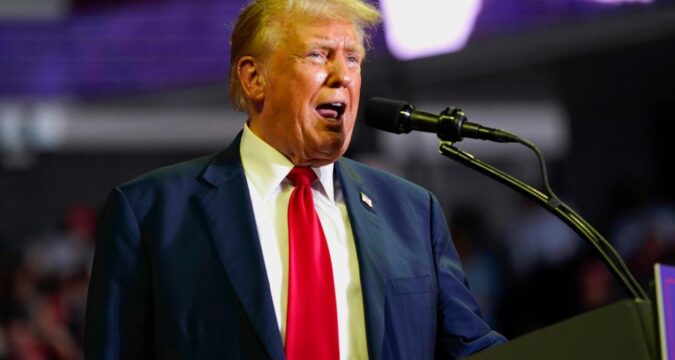
The current demands to inflict punitive pain on adversaries are not coming from a ranting spectator of an overwrought sports game. The source is the current American president. And from the chants of “Lock her up!” during the 2016 campaign to his current invectives, the president’s weapon of choice remains the criminal justice system.
In the past week, the president forced the resignation of the U.S. Attorney for the Eastern District of Virginia, someone he put in the job, because the prosecutor concluded insufficient evidence existed to charge former FBI Director James Comey or New York Attorney General Letitia James with any crime. Trump also publicly excoriated Attorney General Pam Bondi for the lack of federal prosecutions against his enemies.
Michael McAuliffe
His brashness will backfire. Using the American criminal justice apparatus to nakedly target political opponents is like throwing rocks in a room full of mirrors. The harm will be unpredictable, and the injured will not be the intended.
It’s no defense to say that Trump’s prosecutorial directives are in response to an earlier weaponization of law enforcement. It doesn’t matter now whether earlier legal actions were tainted by political motives or not. The Trump camp argued then it wasn’t legitimate to target opponents with prosecution over political matters. They labelled Trump a victim, not a perp, because of Biden’s approach. If political neutrality in law enforcement is the essential standard (and it should be), no exception exists for revenge. No carve-out based on anger is in the waiting.
In fact, Trump’s current justification simply highlights the illegitimacy of the approach — that those in power can ignore the ethical and established practices of federal criminal investigation and prosecution. The result is that the opposition, once back in power, can do the same.
Prosecutors have enormous discretion in deciding whom to investigate and whether to charge. That discretion has been a subject of ongoing debate in this country. However, it’s become part of the DNA of American justice.
Fortunately, the American criminal justice system has some capacity, in theory, to shield against the abusive power of an attorney general or a president acting as direct prosecutor. Judges can dismiss cases after the government presents its evidence if the evidence fails to establish the case. If a U.S. district judge dismisses a prosecution based on the lack of evidence, it acts as an acquittal and is final. The government cannot appeal the dismissal, and double jeopardy attaches to the case. That means the government cannot re-charge the defendant for the same crimes.
Even when a defendant is convicted, appellate courts will review the case for errors, including the evidence, or lack of evidence, introduced at trial. The appellate court can reverse convictions and dismiss cases based on an array of issues, including prosecutorial misconduct.
Ordinary citizens also have the power and ability to reject the federal prosecutors’ cases.
In Washington, D.C., several grand juries have refused to approve proposed felony indictments of individuals for their minor, if insulting, interactions with law enforcement. Trial juries, can, and do, acquit defendants in criminal cases. Because deliberations are held in secret, no reason for the acquittal are given. The jury’s acquittal is final.
More jury rejections of proposed charges and acquittals in trials are likely if the cases envisioned by the president come to fruition.
Also, all DOJ lawyers are officers of the court and members of at least one state bar. If federal prosecutors abuse their authority, the courts could provide individual accountability and dismiss or limit charges in specific cases as a sanction. Judges may well respond differently to prosecutors if their word loses the presumption of integrity.
Trump and his supporters don’t recognize, or appreciate, that the rules, once swept away, will not protect them. Trump’s unreserved, explicit pursuit of prosecutions against political opponents is a new type of friendly fire that injures all, including the chief executive’s most ardent lieutenants, even if only in the future.
Michael McAuliffe is a former federal prosecutor. He also served as the elected state attorney for Palm Beach County. He has been an adjunct professor at the College of William & Mary’s Law School and a senior lecturing fellow at Duke University’s School of Law. He is married to a U.S. district judge.
https://www.sun-sentinel.com/2025/09/25/trumps-politicized-prosecutions-open-an-ugly-door-opinion/